

AI is beginning to understand mixed Chinese and English in real time.
Recently, Meta introduced its real-time audio perception model, Muse Voice Transcribe. Public demonstrations show that even when handling Chinese, Chinese-accented English, and mixed Chinese-English speech, the model can maintain strong real-time transcription performance. It natively supports code-switching, further pushing speech recognition toward more realistic and complex language-use scenarios.
This sends an increasingly clear signal: speech recognition is moving from “hearing standard speech clearly” toward “understanding how people actually speak.”
If you have used voice input powered by the latest foundation models, this change is already very noticeable: voice input suddenly seems to have become “smarter.”
It is no longer an “old-fashioned” system that can only recognize perfectly articulated speech. It is beginning to understand accented Mandarin and mixed Chinese-English input, capture speech in noisy environments, and even understand softly spoken “whispers.”
Behind this is a generational leap in interaction technology—the core competition has shifted from simple “speech recognition accuracy” to “semantic understanding in complex scenarios.”
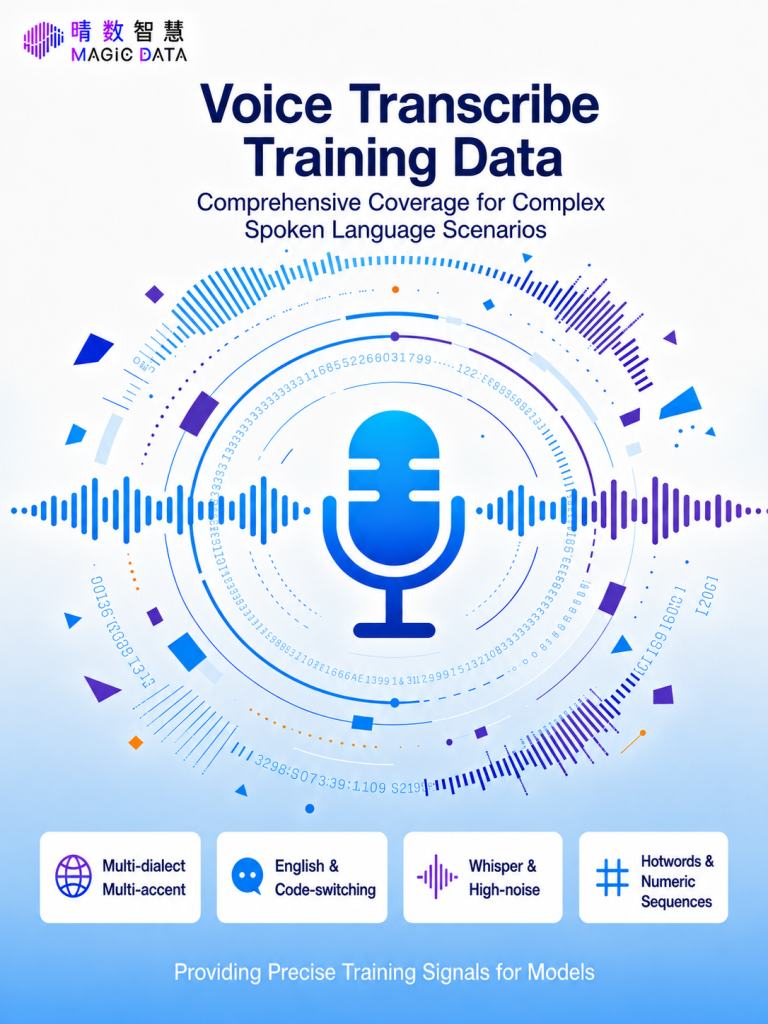
And the foundation for making all of this possible is no longer a single algorithm, but high-quality, diverse, scenario-based speech training datasets.
The Market Window Is Open: AI Voice Input Is Being “Rebuilt”
The entry of leading foundation model companies is overturning the competitive logic of traditional input methods. Voice input now supports multiple dialects, English and mixed Chinese-English input, accurate recognition of fast speech and softly spoken speech, and can even be used smoothly in offline or weak-network environments.
At the same time, more and more AI voice products are beginning to focus on natural conversational phenomena—that is, handling the way people naturally communicate, including stuttering, hesitation, filler words, and other features of spontaneous speech.
This means that market demand for speech training data is undergoing a structural change. In the past, a few thousand hours of clean read speech may have been enough; now, what is needed is diverse speech data covering multiple accents, scenarios, and emotions.
Magic Data: Providing “Data Fuel” for the Next Generation of Voice AI
As a professional organization with years of expertise in conversational AI data, Magic Data has already established a strong presence in this field. Its large-scale, multilingual, scenario-based speech datasets are becoming a key foundation for training AI speech models.
Multi-Dialect, Multi-Accent Training Data: Helping AI Understand Speakers from Across China
According to a 2025 industry survey, dialect speech technology has become a key breakthrough for advancing inclusive access to AI. Magic Data has built speech datasets covering major Chinese dialects and regional varieties including Tianjin, Cantonese, Nanchang, Changsha, Sichuan, and Shanghai. In addition to datasets released for academic open-source use, Magic Data also offers tens of thousands of hours of commercial dialect data, which can effectively improve dialect recognition accuracy in real-world scenarios.
English and Chinese-English Code-Switching Training Data: Essential for Global Interaction
In the feature descriptions of voice input methods, “mixed Chinese-English input” is explicitly listed, reflecting how AI voice input is moving toward more complex multilingual use cases. Magic Data has large-scale speech datasets covering major languages including Chinese, English, Japanese, Korean, and Spanish, providing strong support for multilingual speech recognition and translation models.
Training Data for Complex Acoustic Scenarios: Full Coverage of Numeric Sequences, Whispered Speech, and High-Noise Environments
The value of a high-quality speech dataset lies not only in “what is said,” but also in “the environment in which it is said.” Magic Data’s data products cover a variety of real-world use scenarios:
- Numeric Sequence and Hotword Data: high-frequency vocabulary and numeric sequences in specific domains are annotated for targeted recognition scenarios to help improve recognition accuracy.
- Whispered and Low-Volume Speech Data: whispered and low-volume speech data across multiple domains, with diverse accents and dialects, can effectively improve recognition of whispered and low-volume speech.
- High-Noise Environment Data: speech recorded across diverse real-world acoustic scenarios such as roads, public spaces, and office environments supports robust model training under complex background noise.
Natural Conversation Training Data
High-quality speech data must not only cover complex acoustic environments, but also recreate the way people actually communicate with one another. Magic Data has built natural conversation training data for real interaction scenarios, providing conversational AI, Voice Agent, and real-time voice interaction models with training data that is closer to real-world use.
Magic Data’s natural conversation data is designed to maximize naturalness and interactivity, enabling models to learn how people communicate with one another, including natural conversational phenomena such as interruptions, pauses, and hesitation. Accent distribution is diverse, and the content covers a wide range of topics.
Beyond Data: Compliant, Secure, and Commercially Usable
It is worth noting that as the commercial deployment of AI models accelerates, data compliance and security have become important considerations for enterprises when selecting suppliers. Magic Data has obtained the international certifications ISO/IEC 27001 (Information Security Management) and ISO/IEC 27701:2019 (Privacy Information Management). All datasets are collected in compliance with applicable requirements and licensed for commercial use, supporting commercial model deployment for enterprise customers.
From “Usable” to “Truly Useful”: Data Is Determining the Upper Limit of the Experience
As AI voice input moves from “usable” to “truly useful,” and from “understanding Mandarin” to “understanding the nuances of human communication,” the upper limit of the product experience is no longer determined by small innovations in model architecture, but by whether the “data soil” supporting model growth is fertile enough.
Whoever is first to build up datasets spanning multiple dialects, scenarios, and languages will gain an early advantage in this new “arms race” of AI interaction. For teams building the next generation of voice products, now is the time to take a serious look at their own “data arsenal.”
📩 For dataset details, contact us: business@magicdatatech.com
