
Spending two hours in a meeting only to spend another two hours typing up the notes—this daily grind is rapidly being swallowed up by Voice AI.
But what really determines whether "AI-generated meeting minutes" are useful isn't how polished an LLM's summary sounds. It comes down to something more fundamental: transcription accuracy.
Mishear "500,000" as "150,000", and no matter how polished the subsequent summary looks, it is pure hallucination.
1. Redefining Transcription Accuracy
Traditionally, ASR performance has been evaluated using a single metric: word error rate (WER). The lower the WER, the better.
Real-world meetings, however, are nothing like speech tests. They involve accents, interruptions, overlapping speech, background noise from air conditioning, and business-specific terminology such as "days payable outstanding". A model that achieves a 2% WER in the lab could degrade to 8% in an actual meeting.
That's why one detail from a recent set of independent evaluations is worth noting even more than "the headline result":
Across three independent speech recognition leaderboards—Hugging Face Open ASR, Artificial Analysis, and Coval—the same transcription model ranked first on all three. The six remaining second-and third-place positions were occupied by six different competitors, with no competitor appearing more than once.
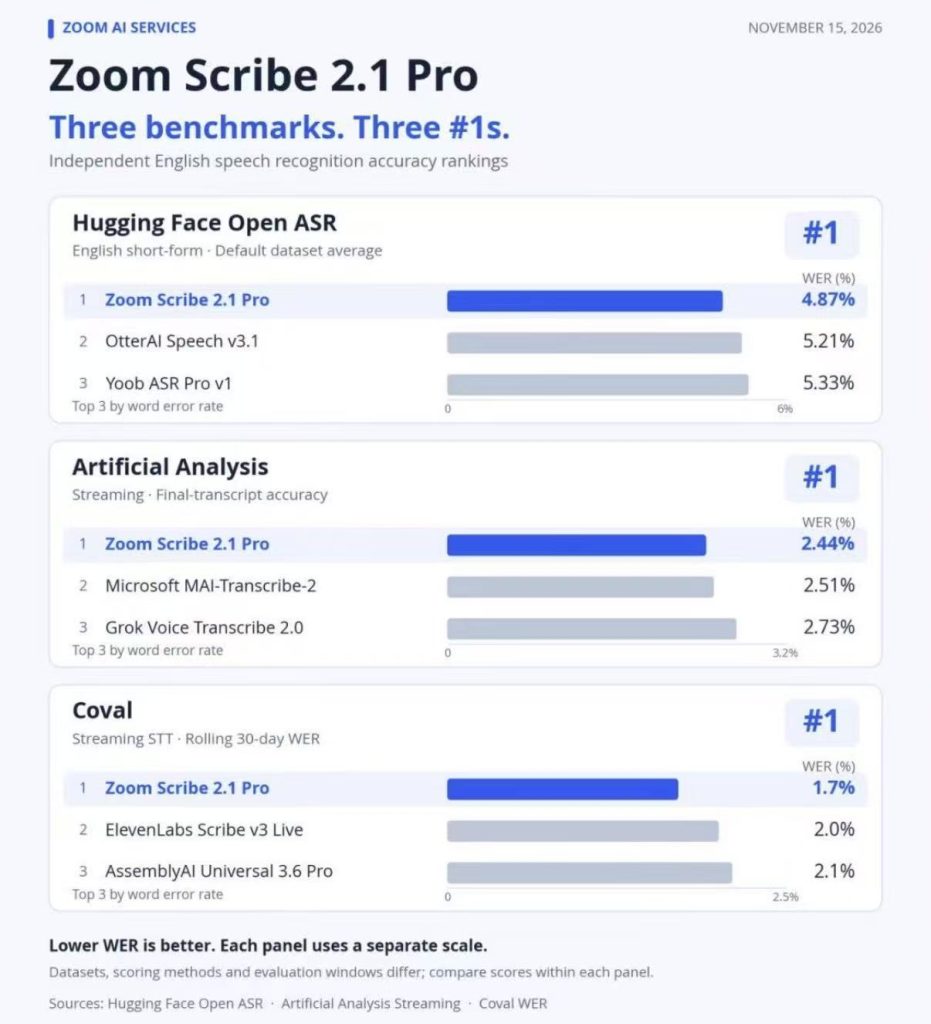
This is precisely the newly released ZAS Scribe 2.1 Pro from Zoom.ai.
While others are still making progress on individual fronts, Zoom.ai APIs is pushing "accuracy, streaming performance, and robustness" to the limit simultaneously.
Consider the numbers:
- 4.87% average WER on public short-form audio
- 2.44% final WER for streaming transcription
- 1.7% WER in streaming scenarios over a rolling 30-day period
In real-world meetings, a 1% to 2% margin is the dividing line between a "passable tool" and a "system you actually trust to publish minutes straight out of the box".
2. Three Hurdles in Real-World Meetings
1. Accents and Domain Jargon
Business meetings are full of product names, acronyms, and code-switching. General models may not recognize specialized terms like "Sophon" or "Onyx", resulting in garbled transcripts.
2. Overlapping Speakers
Participants interrupt one another, chime in with brief acknowledgments, and sometimes speak at the same time. Without accurate speaker Diarization, the transcript becomes a wall of text with no clear indication of who said what, forcing people to replay the recording and sort it out manually.
3. Turning Words into Action
Transcription is not the finish line. What really makes meeting AI useful is timestamp alignment (clicking on text to jump to the corresponding audio), extracting key decisions ("we've decided", "by next Wednesday"), and assigning action items (who needs to do what, and by when).
Each of these steps depends on the accuracy and quality of the initial transcription.
3. Streaming Is the Prerequisite for Full-Duplex Meetings
Another clear shift in 2026 is that teams are no longer satisfied with "recording first and transcribing later".
During a meeting, captions need to keep up with speakers at the same time. When someone interrupts, the system can not ignore them. And when a speaker corrects themselves—"No, I meant next Friday"—the model needs to update the transcription in time.
These capabilities are rooted in full-duplex speech interaction: listening while speaking, handling natural interruptions, tracking changes in emotional state, and dynamically managing turn-taking.
That's the significance of the reported 1.7% streaming WER: it suggests that "low latency" and "high accuracy" no longer have to be mutually exclusive.
For developers, however, the biggest challenge in building full-duplex meeting systems may not be model architecture, but data:
- How should genuine overlapping speech be annotated?
- Does a pause indicate that someone is "thinking" or "yielding the floor"?
- Does a brief "uh-huh" signal agreement or hesitation?
Without annotations that capture these nuances, models can only learn to imitate the surface of full-duplex interaction without truly reproducing its underlying dynamics.
4. Transcription Comes First, Then the Summary
Accurate transcription ≠ good meeting minutes.
A practical meeting AI pipeline looks like this:
Audio → Streaming Transcription → Speaker Diarization → Vocabulary Adaptation → Decision/ Action-Item Extraction → Structured Meeting Minutes → Knowledge Base Retrieval
Transcription is the foundation, and the summary is the structure built on top of it. Only with a reliable transcription layer can the system connect to enterprise knowledge bases, voice agents, and business systems, turning "conversations" into "actionable outcomes".
This is also why multilingual support has become a must-have. For global teams, cross-regional reviews, and client interviews, transcription models must have the capacity to switch between languages automatically, preserve technical terminology, and maintain clear speaker boundaries.
5. Final Thoughts: The Next Stop for Voice AI
Meeting transcription is just the starting point.
Beneath it lies real-time voice agents; above it sits the transformation of enterprise conversations into structured assets, and beyond that, a future where "every meeting automatically crystallizes into searchable, traceable, and actionable records".
Making this vision a reality requires progress on three fronts: more accurate streaming ASR, more authentic full-duplex interaction data, and more open-source frameworks and benchmarks.
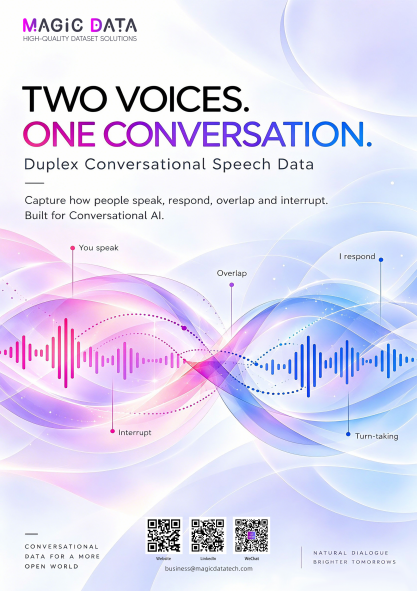
At MagicData and the open-source community MagicHub.com, we have released multilingual full-duplex conversation datasets in Chinese, English, Japanese, Korean, Spanish, and more. These datasets capture the natural rhythms of spontaneous speech and conversation, including interruptions, overlapping speech, backchannels, and pauses, helping developers train models that truly know how to listen and wait.
The meeting isn't over, but the minutes are ready—that's a goal worth working toward together.
